

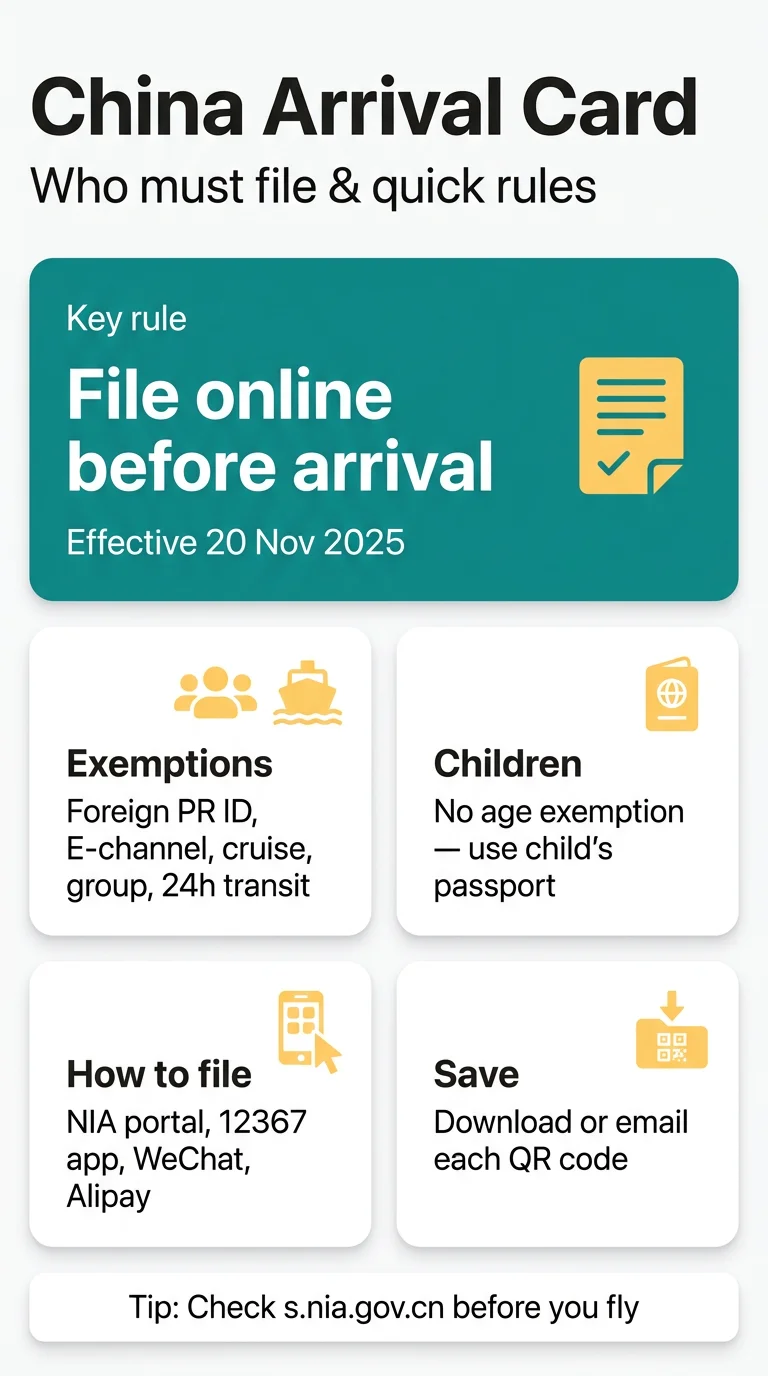
Who needs to fill out China arrival card? Foreign nationals entering mainland China, including visa-free visitors, file the China Arrival Card (Arrival Card) online before arrival. The cited sources list a few exemptions, such as Foreign Permanent Resident ID Card holders. Start at s.nia.gov.cn.
This is an independent guide, not a government site. We don’t charge fees or file the card for you. Use it to work out whether you, your family and your children need to file. Check every rule on the portal before you fly.
Who Needs to Fill Out China Arrival Card?
Foreign nationals file the Arrival Card online before they arrive, whether they hold a visa or enter visa-free. US citizens and other foreign passport holders are covered, whether they hold a visa or enter visa-free. The requirement took effect on November 20, 2025. The card is issued by the National Immigration Administration (NIA). For a broader look at the declaration and border procedures, see our China digital arrival card guide.
A visa waiver removes the visa paperwork. It doesn’t remove the border declaration unless you fall into an exemption category. The form’s entry-policy question offers a 30-day visa waiver and 24/240-hour visa-free transit options, so visa-free visitors are expected to file. If you’re traveling on a US passport, read more about what a US citizen needs to enter China.
| Entry status | Visa paperwork | Arrival Card required? |
|---|---|---|
| Visa held | Visa required | Yes, file online before arrival |
| Unilateral visa waiver | Visa waived | Yes, unless an exemption applies |
| Visa-free transit | Visa waived | Yes, unless an exemption applies |
Check your entry status first. Then read the exemption list below.
Exemption Categories and Edge Cases
The embassy notice lists seven exempt categories. They include Foreign Permanent Resident ID Card holders and 24-hour direct transit passengers who stay inside the port area. Holding a permanent resident card? Then you’re in the first row, as long as the card is valid. If your trip involves a connection, our guide to arrival card requirements for China transit explains the airside and landside rules.
| Category | Exempt? | Condition | Verify with |
|---|---|---|---|
| Foreign Permanent Resident ID Card holders | Yes | The card is valid | Embassy notice |
| Non-Chinese citizens with a Mainland Travel Permit for Hong Kong and Macao residents | Yes | You are a non-Chinese citizen holding a valid permit | Embassy notice |
| Group travelers | Yes | You hold a group visa or qualify for group visa-free entry | Embassy notice |
| 24-hour direct transit passengers | Yes | You stay within the designated area of the port | Embassy notice |
| Cruise passengers | Yes | You enter and depart on the same vessel | Embassy notice |
| E-channel travelers | Yes | You enter through the E-channel (fast-track entry lanes) | Embassy notice |
| Foreign crew members | Yes | You work on exit-entry transport vehicles | Embassy notice |
The transit exemption is narrow. If you leave the designated port area, that wording no longer covers you.
The APEC Business Travel Card is not on the embassy’s exemption list.
Rules for Infants, Children, and Minors
The cited official sources list no minor-specific exemption. Children and infants fall under the general rule for foreign nationals. The sources give no age threshold either, so don’t rely on a cutoff for babies. The embassy notice does not address children separately, so the exemption categories apply to any traveler who meets them.

Check how filing for a child works on the NIA portal at s.nia.gov.cn.
Gather the passport
Gather each child’s passport, since the digital form works from the passport identity page.
Separate form per traveler
Each traveler fills in a separate form with their own passport details.
Check the details
Check each child’s name, date of birth and passport number against the passport.
Save the QR code
Save or email the QR code for each traveler.
What to Prepare and How to File
File before you arrive through the NIA web portal, the NIA 12367 app or the WeChat and Alipay mini-programs. On arrival, you can use kiosks or a paper card instead. For the full walkthrough, see how to fill out the China arrival card step by step. The form asks for the following:
- A clear photo of your passport identity page. The system fills in some fields, and you check and complete the rest.
- Passport number, plus flight, train or vessel number if it applies.
- Visa or other entry permit: yes or no, and the visa number if yes.
- Address and destination cities in China, plus any transit cities.
- Inviting entity (yes or no) and confirmed departure itinerary (yes or no).
- Purpose of entry, contact number and email. Your Chinese name is optional.
These are the channels:
- The PC portal at s.nia.gov.cn/ArrivalCardFillingPC/, reached from the NIA home page.
- The “NIA 12367” mobile app.
- The WeChat mini-program.
- The Alipay mini-program.
- A QR code scanned via mobile phone.
On arrival, the embassy notice names connected kiosks at ports of entry, a QR code scan or smart devices on site. It also confirms a paper-based Arrival Card. If you’re weighing the two formats, compare the digital arrival card and the paper form.
The same form gives you an electronic card with a QR code. You save it with “Download to Local” or “Send to Email” and show it at immigration checks.
Common Filing Mistakes to Avoid
These are common filing mistakes to avoid.
- Trusting auto-filled passport data. Compare names, dates and the passport number with the passport itself.
- Entering a vague address in China. Give the hotel or host address and your destination cities.
- Choosing the wrong entry policy. Answer the visa question truthfully, and if you hold no visa, pick the policy that matches your trip.
- Skipping the card because you’re visa-free. Only an exemption category lets you skip it.
- Paying an intermediary. Use the NIA channels listed above to fill in the form.
- Expecting to edit later. The sources describe no editing mechanism and don’t say how long a QR code stays valid. Check the NIA portal at s.nia.gov.cn for current options. If you lose your QR code, see how to retrieve your China arrival card.
Border Checks and Look-Alike Documents
The Arrival Card is an inbound identity and itinerary declaration. It is filed in addition to any visa or other entry permit you hold. Immigration checks your QR code at the border. The cited sources give no fine amounts, so don’t trust figures quoted elsewhere.
| Document | Purpose | Arrival Card needed? |
|---|---|---|
| Entry visa | Permission to seek entry | Yes, you still file |
| Foreign Permanent Resident ID Card | Permanent residence in China | No, exempt while valid |
| Mainland Travel Permit for Hong Kong and Macao residents | Travel permit for those residents | No, but only non-Chinese citizens holding it are exempt |
| APEC Business Travel Card | Business travel facilitation | Not on the exemption list; only E-channel entry is exempt |
For final confirmation, go to s.nia.gov.cn.
Frequently Asked Questions (FAQ)
Who needs to fill out China arrival card if I’m a US citizen entering visa-free?
You do. A US passport counts as a foreign passport, and visa-free entry waives the visa, not the declaration. The only way out is an exemption category, such as a valid Foreign Permanent Resident ID Card. File online before you fly.
Who needs to fill out China arrival card for a baby or young child?
The cited official sources do not mention infants or set an age limit, so a baby falls under the general rule for foreign nationals. To check how a parent files for a child, see the NIA portal at s.nia.gov.cn.
Do Foreign Permanent Resident ID Card holders need to file an arrival card?
No. Holders of a valid Foreign Permanent Resident ID Card of the People’s Republic of China are on the embassy’s exemption list, so they do not need to file, as long as the card is valid.
Does an APEC Business Travel Card exempt me from the arrival card?
The APEC Business Travel Card is not on the embassy’s exemption list. Only travelers entering through the E-channel are exempt, so confirm your case on s.nia.gov.cn.
Is the China arrival card free, and how do I spot a scam site?
Start from s.nia.gov.cn or the NIA 12367 app rather than a link someone sent you, and be cautious with any request to pay for the card.
Can one phone be used to submit cards for the whole family?
The sources do not say whether one smartphone can file for several travelers. Each completed card includes a QR code, which you can save to your device or send to your email before you travel.
Where do I fill out the China arrival card online?
Use the PC filing page or start from s.nia.gov.cn. You can also use the NIA 12367 app, the WeChat or Alipay mini-program, or scan a QR code with your phone.
What if I arrive in China without having completed the card?
Use the fallback at the port: connected kiosks, a QR code scan, smart devices on site, or a paper-based Arrival Card. Filing beforehand is the route the embassy notice describes. The sources give no penalty amounts, so check the NIA portal at s.nia.gov.cn for current rules.
Sources and Further Reading
- China Launches Online Arrival Card for International Travelers: the embassy notice with the effective date, filing channels and exemption list.
- NIA Arrival Card Filling portal: where you file the card and check current rules.
Rules can change, so check the portal before you travel.