

What is required for a US citizen to enter China? In most cases: a visa from a Chinese consulate, a valid passport, and an arrival card for each entry. The card isn’t a visa and doesn’t replace one.
This independent guide isn’t a government site. Current rules are on the U.S. State Department’s China page and the Los Angeles Chinese consulate site. Confirm details there before you travel.
What Is Required for a US Citizen to Enter China?
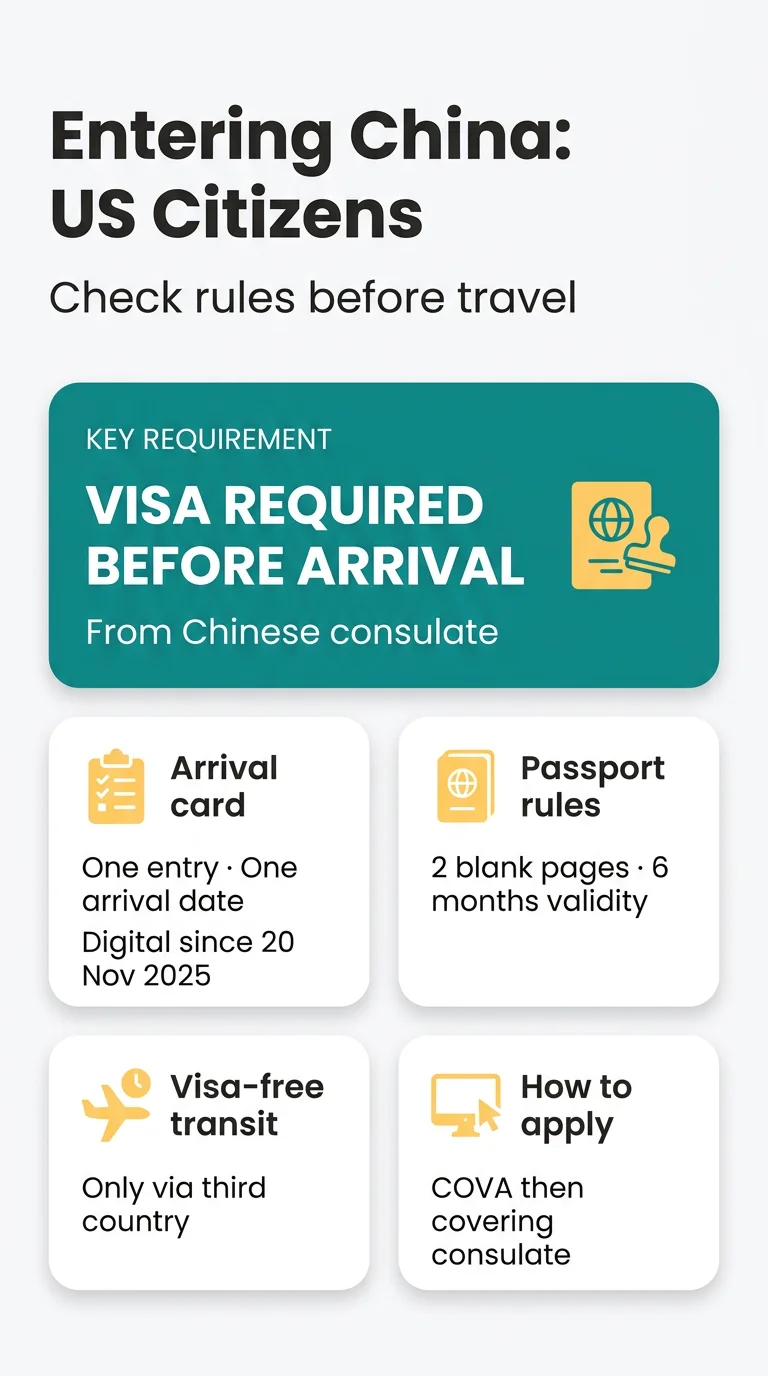
A visa comes first. The State Department says US citizens need one before arrival in most cases. Visa length and number of entries depend on the visa category and the consulate’s decision.

The arrival card is a declaration under the National Immigration Administration (NIA) for one entry and one arrival date. The digital China Arrival Card system was introduced around 20 November 2025. A card is required on arrival, and filling it in online before you travel is recommended. If you’re unsure whether the declaration applies to your trip, see who needs to fill out the China arrival card.
| Compare | Visa | Arrival card | Border admission |
|---|---|---|---|
| Issued by | PRC consulates abroad | NIA | NIA border officer |
| Lasts | Set by the consulate; depends on visa category | One entry | Each arrival |
| When | Before you travel | Before landing or at the port | At the port |
| Effect | Permission to travel to a port | Records your entry data | Final decision on admission |
One caveat: a valid visa doesn’t guarantee entry if the card or passport checks fail.
Visa and Passport Rules for Americans
Americans generally need an L (tourist) visa. You apply online through the China Online Visa Application (COVA), then submit to the consulate covering your state. There is no visa application center in the US, so you apply at the consulate covering your state.
Round-trip tickets, a hotel booking or an invitation letter may be requested. Simplified L-visa rules don’t require them as standard, but consular officers can ask for extra documents.
Your passport needs at least two blank pages and six months of validity after entry. Your passport should be valid for at least the length of your stay. Plan for six months’ validity after arrival to be safe. The Chinese Embassy’s FAQ (24 December 2024) states the general rule as validity for at least the duration of intended stay.
| Traveler | How you apply | Documents | Arrival card |
|---|---|---|---|
| US citizen | COVA, then a consulate | Visa, passport | Yes |
| UK or Australian citizen | CVASC | Visa, passport | Yes |
| Visa-exempt or transit | No visa | Passport; check waiver rules | Usually yes; check transit rules |
- Los Angeles consulate: 443 Shatto Place, +1-213-8078088, Mon-Fri 9:00-12:30 and 13:30-18:00
- New York consulate: 520 12th Ave, 212-8682078, Mon-Fri 9:00-15:00
- Washington DC embassy: 3505 International Place NW, +001-202-495-2000
What Is Required for a US Citizen to Enter China Visa-Free?
Visa-free options are narrow. The US isn’t on China’s 30-day unilateral visa-free list. The exception is China’s transit policy, which allows eligible travelers continuing to a third country to stay visa-free through approved ports. Confirm ports with the NIA or a consulate.
- Los Angeles → Shanghai → Tokyo: continuing to a third country qualifies for visa-free transit.
- Los Angeles → Shanghai → Los Angeles: a direct round trip isn’t eligible.
Transit passengers who stay briefly without leaving the port area may follow a simplified process, so check whether it applies to your route. For a full breakdown, read the airside vs. landside rules for China transit arrival cards. Hong Kong and Macao have their own entry rules, so check them separately.
Returning to the mainland after a Hong Kong trip counts as a new entry, so a single-entry visa won’t cover it. You’d need a multiple-entry visa and a new arrival card. Planning a Hong Kong side trip? Apply for multiple entry.
How to Complete the Arrival Card
Check which formats your port of entry offers before you travel. Options typically include online completion, a QR code, a self-service kiosk or a paper card. For more on the two main options, see our comparison of the China digital arrival card vs. the paper form.
Gather your documents
Passport, flight number and accommodation address
Choose a format
Online, kiosk or paper, depending on your port
Fill in the fields
Copy your details from your passport
The form typically asks for: full name, date of birth, nationality, passport number, issuing country, expiry date, flight or transport number, port of entry, date of arrival, hotel name and address or host or company details, purpose and length of stay, and contact phone or email. A full list of the information needed for the China arrival card can help you prepare in advance.
The card covers one entry and one arrival date, so a changed date or port needs a new card. Submitting the official card carries no service fee. Paid private services are optional.
Inspection After Landing
At the border, an officer checks your passport, visa and arrival card. Entry can be refused.
Common Mistakes and Where to Verify Rules
- Treating the card as a visa. It doesn’t replace one, so get the visa first.
- Assuming the card doesn’t apply to you without checking the rules for your visa-free or transit status.
- Booking a direct US-China-US route under transit rules. Route via a third country.
- Leaving for Hong Kong on a single-entry visa. Get a multiple-entry visa.
Check rules shortly before departure, because policies change. Consular fees follow the consulate’s schedule, and the official card carries no service fee; paid services are optional. Be cautious with paid private services, which charge for help with a free form. To file the form yourself at no cost, see our guide on why the China digital arrival card is free and how to avoid broker fees. Watch for sites that impersonate government portals, ask for unencrypted data or promise guaranteed entry.
Frequently Asked Questions (FAQ)
What is required for a US citizen to enter China?
A consular visa (usually L for tourism), a passport with enough validity and blank pages, and an arrival card for each entry. Limited exceptions exist, such as transit through approved ports. Check the State Department’s China page before you book.
Does a Chinese visa replace the China arrival card?
No. The visa is permission to travel to a port of entry, while the card is a separate declaration for that one trip. You file a new arrival card for each arrival.
What is required for a US citizen to enter China without a visa?
Only narrow routes exist. The main one is transit through approved ports with onward travel to a third country. You still complete the arrival card, so confirm eligibility with the NIA or a consulate before booking.
Can I use China’s transit policy on a round trip from the US?
No. Your itinerary has to continue to a third country, such as Los Angeles to Shanghai to Tokyo. A direct return to the US doesn’t qualify, so build the third country into your booking first.
Where can I check current Chinese entry rules and apply for a visa?
Start with travel.state.gov, then your consulate in Los Angeles, New York, or the embassy. Visa applications start in COVA. This guide doesn’t process visas.
What happens if I make a mistake on my arrival card?
The card covers one entry and one arrival date, so check every detail against your passport and flight before you submit. If you spot an error, ask airport staff or the consulate what to do.
Do I need to register my address in a private apartment?
Address registration rules for private accommodation can differ from hotels, so check the current requirements with your host and confirm them with the local authorities or your consulate before your stay.
Can I visit Hong Kong and return on a single-entry visa?
Usually not. Returning to the mainland counts as a new entry, so you’d need a multiple-entry visa and a new arrival card. Arrange one before the trip.
Sources and Further Reading
- travel.state.gov: China travel advisory
- Los Angeles consulate: visa information
- New York consulate: visa services and contact details
- Chinese Embassy: passport and visa FAQs
- visaforchina.cn: visa center portal
- U.S. Consulate General Hong Kong & Macau: travel advisory for Hong Kong
Rules can change, so check the portals before you travel.